Monday, January 6, 2014

The Gift of Reading


As frequently happens when I’m reading Facebook posts, I clicked on a link and traveled off in a whole new direction. A teacher friend posted a link to Terry Heick’s article “Why Students Hate Reading–And Often Aren’t Very Good At It” on teachthought.com. Heick points out that in our fast-paced Instagram world, students are not encouraged to connect at a deeper level with the people and situations they are reading about. I heartily agree. By emphasizing reading as a decoding process, by breaking it into its parts of main idea and details, students are not able to stop and reflect on how the lives in the story connect to their lives.

His article caused me to reflect on how I came to love reading. How was I, a middle-class white girl raised in a stable two-parent home, able to empathize with Huck Finn's being abused by his drunken father or with Helen Keller's struggle to communicate despite being blind and deaf?  These were not my experiences, yet as I read these stories, I was able to imagine myself in their shoes. Clearly these were well-written stories, but there's more to it.

My love of reading has a lot to do with the people who loved me enough to read to me. Night after night either my mother or father would snuggle up next to me and read from one of my favorite books. There were books of poetry as well as stories. I requested some poems, like Rachel Field's "General Store," so often that I began to recite them on my own. Then there was
Betty MacDonald's Mrs. Piggle-Wiggle's Farm which I inscribed with my name and this succinct review, "This is a very funny book." How could it not be considering it had characters named Fetlock Harroway, Freda Workbasket , and Crystal Mallett, not to mention a cow named Arbutus and a horse named Trotsky (Hmm, a Cold War message here?).

These people who loved me more than anyone else on earth wanted to share reading with me, and by doing so, they showed me how I could connect with mere words on a page. Then when I was in fifth grade I had a wonderful teacher--Mrs. LeBel. She was exceptional for many reasons, but, not the least of them, was that she read to us. For years I've been trying to remember the name of the book about two orphan girls that she read to us a chapter at a time. Today, thanks to Google and Amazon, I have a copy of Nancy and Plum wending its way to me, and, ironically, I discovered it was also written by Betty MacDonald.

Had Mrs. LeBel presented MacDonald's words as tools, or had she asked us to strategize how to understand the story, I am sure that experience would not have stayed with me these 60 years. Instead, we stopped whatever we were doing, and she shared with us not only the story, but her time and her love of reading. What a gift!


Saturday, December 28, 2013

Who Rescued Whom

In her book Ancestral Intelligence Vera Schwarcz shares her renditions of some of the "jottings" of Chinese historian and poet Chen Yinke (1890-1969). She describes Yinke as, "a man who never tired or rescuing words." The idea of poet as rescuer appealed to me. Ironically I see it the other way around too. Sometimes I am rescued by a word.


Yesterday I was working on a collection of poems I started two years ago, although some of the poems are older than that. I made a New Year's resolution in 2012 to complete the collection. Then last year, since I hadn't finished it, I re-resolved to do it in 2013. It's not totally finished yet, but at least I have selected the poems that will be the collection.

For me, revision is an unending process. As Paul Valery said, "a poem is never finished, only abandoned." So as I was going over these poems, there was one with a title I didn't like. I like my titles to enhance the poem without giving too much away. This title was flat out exposition. I turned to my old friend Roget and looked up the word "thanks." I was offered twelve choices beginning with "gratitude" and ending with "gramercy." Gramercy? Wasn't that a park in New York? Well, indeed, it is, but it seems there is also an archaic meaning of expressing thanks from the French: grand merci. (Evidently the etymology of the NYC park goes back to a Dutch word meaning "little crooked swamp," but that didn't make any sense for my poem).

So now I have  poem titled "Gramercy." I was excited about finding this word and putting it back in circulation, and, at the same time, grateful to Roget for rescuing me from a dull title. Gramercy to Monsieur Roget.

I haven't decided what my New Year's resolution for 2014 will be, but I still have a few days left.


Friday, December 20, 2013

My Churches


On Christmas Eve after the presents are opened, the dishes loaded into the dishwasher, and the guests have left for home, I will sit for just a minute and look at the tree. Then I will bundle myself up and travel down the road to the candlelight service at church. This is always a highlight of my holiday. The beautiful music, the warm candlelight, and the familiar story of wanderers finding crude shelter where their baby will be born amid the animals all remind me once again of what this season is about.

When I speak here of church, I am speaking of the church I attend nearly every Sunday—Trinity United Methodist Church in Springfield, MA. The stone cathedral structure next to Forest Park is quite recognizable to anyone in the Springfield area. It is a beautiful building, but when I refer to the church, I am really talking about the people there. Everyone from the toddler playing peek-a-boo from two pews up to the man from AA who comes in silently, then leaves. Trinity is a warm and welcoming place.


This is why it pains me so when I hear about the other church—that larger church we are a part of—The United Methodist Church. That church has been in the news lately and not for being warm and welcoming—quite the opposite. That church has tried and convicted one of its clergy for violating church law—a law that forbids clergy from marrying couples of the same sex. In effect, that church has punished one of its members for showing love and compassion.

I struggle with being a member of these two churches, and I know I’m not alone. Can I go along worshiping and working in the church that ministers to everyone while, at the same time, being a part of that other church that excludes, judges, and condemns? I don’t know.

A couple of Christmases ago as I entered Trinity for the candlelight service, I saw one very bright star alone in the sky right over the church. I thought, of course, of the Magi who were guided by the star. This Christmas I will pray for that light to fall on both of my churches.


My Church

This is my church - doors open to the noise of the city
This is not my church - doors safely closed

This is my church - hands stretched across barriers
This is not my church - hands rigidly folded

This is my church - a harmony of diverse voices
This is not my church - a monotone of narrow doctrine

This is my church - hearts warmed by love
This is not my church - love limited by decree

My church -
not the closed inn doors
but the welcoming stable.


Monday, November 11, 2013

Tongue-tied

I am taking a Spanish class. It is not my first. I took two years of Spanish in college, but didn't get a lot out of it. This short class is designed to help those of us going on a mission trip to Nicaragua become somewhat conversant. I was pleasantly surprised at what was still residing deep down in the gray matter, and discovered again how my French (3 years of high school French) keeps intruding on my Spanish.

I wish I had continued my French in college, but I didn't feel prepared. The teachers I had for my first two years of French were excellent. First there was Miss Accorsi at Forest Park Junior High.  Remember Miss Grundy from the Archie comics? Replace the frown with a patient smile, color the dress gray, and that's Miss Accorsi. She may have looked like something out of a comic book, but she was the real thing. For the first six weeks of class we had no books, but learned to converse extensively about les crayons et les cahiers before we opened nos livres and began to learn about the difference between passe’ compose' and l'imparfait.

At Technical High School  Miss Roy made French fun as we heard
about her trips to Paris, sang songs, and learned about Edith Piaf. I even, and I find this hard to believe myself, wrote a sonnet in French in her class. Sadly all I remember about French 3 was that Miss Murray had short bleached blond hair, on top of which she had a huge bow, making her look like an overgrown kewpie doll—the extreme opposite of Miss Accorsi. So when I had to pick a language in college, I picked Spanish.
 
I wish I had continued with my French so that I came to know it really well, or else had started out with Spanish in the first place. As a result of knowing a little French and even less Spanish, I am envious of those who speak more than one language well. And what really annoys me are people who see their monolingualism as a badge of honor, insisting the rest of the world speak English. At the school where I taught, we had students from many different countries who spoke numerous languages. Many of them spoke several languages, yet others were critical because their English wasn't perfect.

Put aside the fact that being able to converse in more than one language is an advantage over frowning and waiting for an English translation. English is not an easy language to learn, and I say that as an English teacher and someone who loves the language. First there is the spelling. Why in the world should cough be spelled c-o-u-g-h when off is spelled o-f-f? Then there are those crazy words that are their own antonyms like left. It can mean that someone is gone, or what remains. And when the cops on TV dust for fingerprints, how is that not the same as what they're doing on the Pledge commercial? Adding dust or taking it away?

Being a lover of the language, I enjoy reading dictionaries, seeing the roots of words. Knowing the word's story, knowing, for instance, that the word sinister comes the Latin meaning left--oh, yes, there's yet another left--this one meaning the opposite or right-- which has several other meanings. Oh, it's all a wonderful mess of a language. From the little I know of other languages, I suspect they are not as complicated, which is why I admire those who really can speak more than one. Now back to los libros.

Buenas di’as, mis amigos!

Monday, October 21, 2013

October Thoughts


"A lifetime isn't long enough for the beauty of this world
and the responsibilities of your life."
Mary Oliver

Once again Mary says it perfectly. Recently I am feeling blown away by the wonderful things around me: sharing time with old friends, the glory of autumn, the warm weather, the gathering of families at a church event, the gathering of poets at a reading, and, of course, having the opportunity to see the Red Sox win the American League Pennant from Section 30 of Fenway Park. In between all this, there are the things one must do that sometimes include saying goodbye to those things that are most precious.
 
Last week I had the opportunity to have lunch with one of my oldest friends (not in age; she's actually a bit younger than I, but in the length of time we've known each other). We met in college. We've been together at some of life and history's most important moments. I was there when she married her husband who is also a friend, when her children were born, and when, from a small black and white television in their first home, we watched Neil Armstrong walk on the moon.

We always look forward to being together. We share memories and laughs, and not a few tears. Sometimes they go together. At exactly the same moment that I am filled with the exquisite beauty of the maple's gold, I know it means winter is coming. Last week my friend told me that her husband's cancer has returned. Complicated by other medical issues, surgery is not an option. An appointment next week will determine treatment.
 
I wonder how to hold the beauty of our friendship, the richness of our history together with the weight of her sadness. Life isn't long enough to understand this. Yet, somehow, I suspect they are coupled. To be able to be there for my friend now as she cries, admits that she fears being alone--this is a thing of beauty undergirded by the many happy memories we share.
 
Much of the poetry I have written has been about spring, rebirth, and especially the persistence of the crocus cutting through the last of winter to bloom. It is a message I will return to, but  at this moment in my life--maybe because I just attended my 50th high school reunion--I am appreciating the beauty of that single gold leaf that started as a tiny bump at the end of the branch, that grew to a full green palm, that day after day gathered a piece of sun to do the tree's work, that danced in the breeze, that weathered the hurricane, and that now as it relinquishes its hold on the branch where it began, descends in a magnificent golden pirouette.

Saturday, October 12, 2013

Just Another Walk in the Park

One of the many great things about having a dog is that it forces you to get out and walk. One of the great things about living in Springfield is getting to walk in Forest Park, hence Riley and I spend a lot of time walking in the park. Riley loves to walk, and the minute I turn my car off Sumner Avenue, wave at the familiar face in the ticket booth, and head down the road, he's sitting up and sniffing, knowing there’s adventure is afoot.  

We walk here in all seasons. If we come on a nice weekend day in the summer, we are weaving our way through picnickers, little leaguers, bridal parties, and runners. In the winter we are apt to be almost alone. No matter the season, it is always a rewarding visit. We have several routes--the path through the rose garden, the walk around the lily ponds, and, in the winter, the track around the playing fields because it is plowed. Yesterday we took my favorite route--around the lily ponds, up to the mausoleum, by the Carriage House, Prouty's Grove, and back down to the duck ponds.  It was a grey day, but the fall colors were glorious.

Even as the structures for"Bright Nights" were being erected, nature shone through. The reds and yellows of the maples, the floating leaves in the stream, the amazing lotus seed pods—all worthy of a poem. The Bright Nights’ version of deer jumping over Magawiska Road was already up, but it reminded me
 of just a couple of months ago when I saw three real deer
crossing the same road right in the same spot.  


Going on this walk always brings back memories since I've been coming here since I was very small. I remember family picnics near the waterfall, visiting the museum that was housed in the Barney Estate before it was torn down to make way for I91, running up the steps of the mausoleum, watching my grandfather trying to get the peacocks to spread their feathers, and skating on Porter Lake. I also remember Mr. and Mrs. Prouty who used to play bridge with my grandparents.  

To be honest, yesterday I thought about taking a shorter route just around the ponds and going on my way, but Riley started heading up the hill, so I followed his lead. The colors, the sounds of the birds, the fresh fall air--all made me feel so refreshed and grateful. Over and over I am grateful to O. H. Greenleaf and Everett Barney for donating this land to the city in 1874, and for all the successive generations who have kept it up. It's good to remember in these days of gated neighborhoods, that public space and public parks are a good thing for everyone.

Monday, September 30, 2013

Golden Door?

In a couple of weeks I will be attending my 50th high school reunion. Yikes! Besides causing me to notice the accumulating wrinkles appearing in my mirror, it has caused me to reflect on my many years in public education--17 years as a student from kindergarten through college and 35 as a teacher. I believe in the principles of public education, but what Horace Mann called, "the great equalizer of the conditions of men" [sic] is becoming less and less equal.

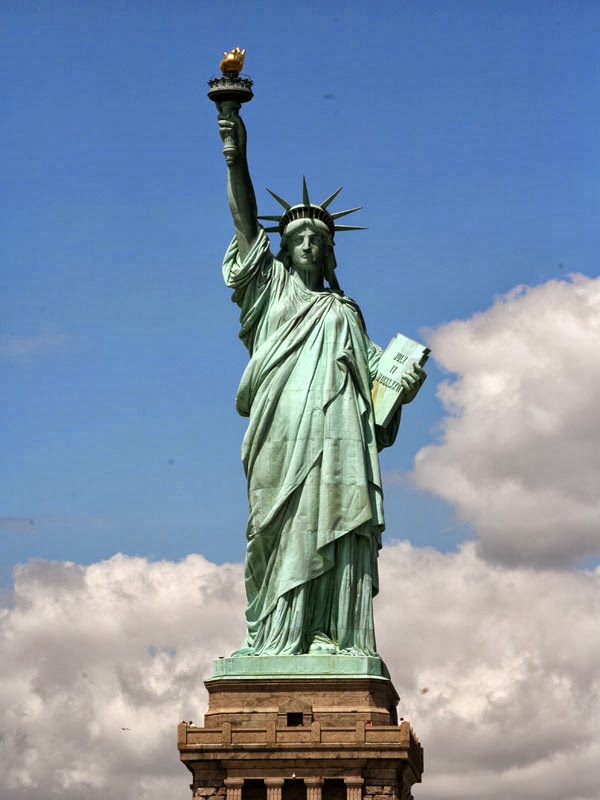
Public schools are the Lady Liberty of education. We are the golden door (frequently peeling) open to the homeless (literally) and tempest-tossed. We accept (by law, we must) everyone.  We accept the boy just off the plane from Iraq, the girl in her third foster home in six months, the twins separated by divorce, the boy who works 12 hours a day and gets paid under the table so he can feed his family, the 14 year old who reads on a second grade level, the gang member wired with an anklet, the girl who hasn't spoken in five years (We suspect abuse, but really don't know why). Sprinkled among them are the kids from well functioning families who get three balanced meals a day, dance lessons, tutors, vacations to Disney World, and emotional support. At least this is the way it used to be before the myth of "School Choice" gave birth to charter schools, magnet schools, and other variations of the same, and the sprinkles became fewer and fewer.

I say "School Choice" is a myth because not everyone has a choice. We know that students whose parents are involved in their education are generally more successful. Parents who visit schools, check homework, communicate with teachers and staff, attend PTA meetings, and are otherwise aware of what's going on in the school are able to guide their children through any rough spots they may encounter. These are the types of  parents who "choose" where their child goes. These are the types of parents whose children will fill the charter and magnet schools, not the children whose parents are not so involved.

Why aren't they involved? Certainly there is some dysfunction there, but  there are also the parents who can't speak English, those who are working three or four jobs just to put food on the table, those whose own poor educational background inhibits their understanding of what the "choices" are. The children in these families didn't choose their parents or the conditions in which they live. These children do not get to choose; these children remain in the public schools, despite what some would see as better "choices" for them.
 
Charter and magnet schools are the ones that choose. They choose whom they admit, what they teach, what activities they provide, and whom they exclude. It is understandable that parents who want the best for their kids may be impressed by "improved test scores." I'll save my rant about high-stakes testing for another day, but just a comment here--if a school can choose who takes the test, it thereby skews the scores in its favor. The test results of the public schools, where everyone takes the test, are also skewed but not positively.


Mann describes public education as an ark, outside of which, "all is deluge." What he didn't anticipate were all the pleasure crafts sailing away.